
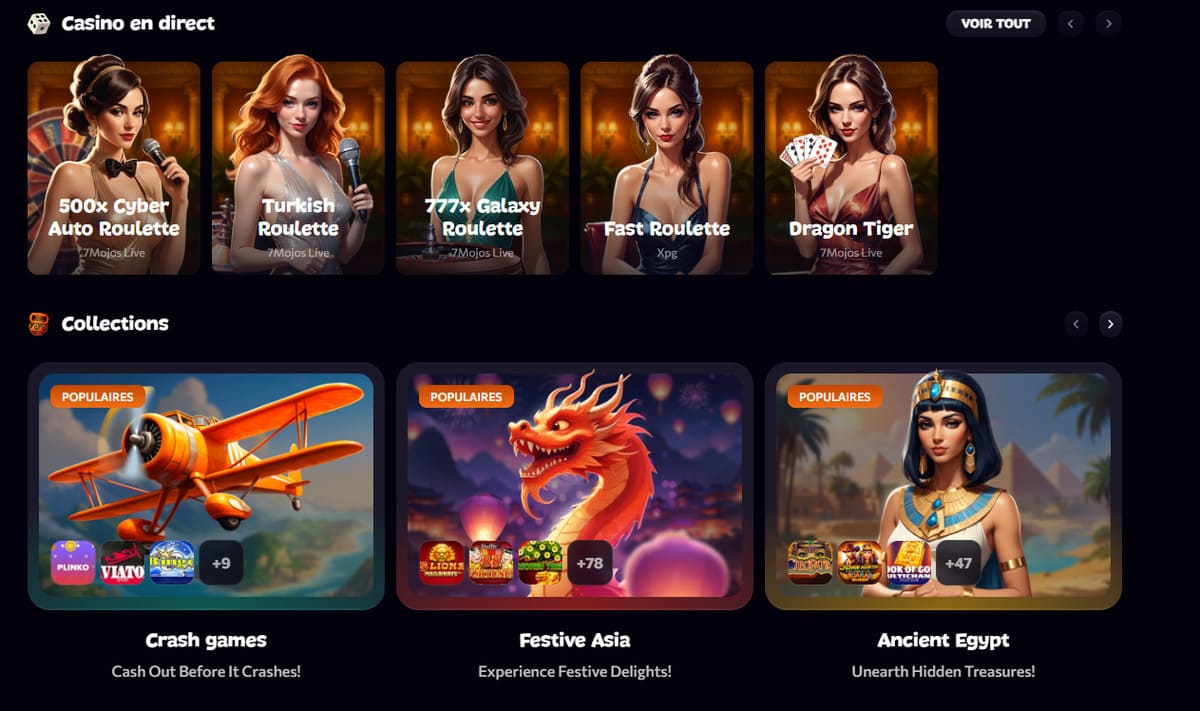
When considering the modern online casino environment, the segment that has genuinely reshaped player anticipations is the live dealer segment. It closes the difference between the isolated character of digital gaming and the communal ambiance of a actual casino floor. Instead of relying on a random number generator, each card handed out and any wheel spun takes place in real time, executed by a expertly trained human croupier. For players in France, this format has grown into the gold standard for confidence and engagement. We want to walk you through each aspect of this adventure, from the tech that runs the stream to the particular protocol that keeps the virtual tables appear like home. Grasping these factors transforms you from a passive observer into an knowledgeable participant.
Financial Operations and Fund Administration for Real-Time Tables
The economic workings of accessing a dealer table vary considerably from traditional virtual slots. As you are dealing with a restricted amount of seats and real-time action, the funding and cashing-out system must be smooth. We consider that the best approach is to hold a distinct wallet for real-time dealer games, separate from your sportsbook or slot balance, if the site allows. This avoids the frustration of experiencing a roulette bet fail because your money are locked in a active sports wager. When you enter a session, the cashier is built directly into the interface, allowing you to top up your funds without exiting your position, usually via a pop-up interface that maintains your connection you from the broadcast.
For French players, the selection of available payment types is vital for smooth transitions. The listed payment types commonly allow live dealer deposits, with settlement rates differing by type:
- Immediate bank transfers and card transactions: Visa and Mastercard transactions are usually processed immediately, allowing prompt access to the tables. Withdrawals, however, need a standard 1-3 business day processing period owing to anti-fraud checks.
- Online wallets and digital options: Platforms like Skrill, Neteller, and PayPal (where available) offer the fastest withdrawal times, commonly processing within 24 hours. They act as a buffer, holding your primary bank details off the gaming ledger.
- Prepaid vouchers and local options: Paysafecard is a widely used choice for funding a set limit, although it usually cannot be used for withdrawals, necessitating an alternate cashout method to be registered.
- Bank wire transfer: Appropriate for high-rollers moving larger sums to the high-stakes baccarat tables, but processing can take 3-5 business days and may entail a hand-operated verification step by the finance team.
Prior to starting a big-money session, we recommend verifying the deposit-to-withdrawal ratio policies. Some operators mandate a total wagering of the deposit before a withdrawal is authorized, a typical anti-money laundering measure. The main factor is to have your account verified in advance. Uploading your identity documents before a big win ensures you will not be held up for KYC approval while your withdrawal remains pending, a vital step for a stress-free live gaming experience.
Game Types and Rule Details
While many of us are knowledgeable about letemps.ch traditional Blackjack and European Roulette, the live dealer lobby has evolved into a collection of specialized, region-specific content that warrants a closer look. Beyond the traditional seven-seat Blackjack tables, we see a rise in unlimited-seat variants where numerous players can place bets on the same hand simultaneously, each performing individual decisions on the digital interface. This removes the annoyance of awaiting a seat to become available. For roulette enthusiasts, the distinction between single-zero and double-zero wheels is only the start. Several studios now provide speed roulette, where rounds end in under 25 seconds, and auto-roulette, which functions without a dealer’s verbal commentary, appealing to players who prefer rapid turnover over social interaction.
The game show category embodies a significant shift from traditional table games. Games like Crazy Time or Monopoly Live blend mechanical spinning wheels with augmented reality animations. In these games, the dealer is less a croupier and more a host, guiding you through bonus rounds that occur in fully rendered 3D environments. For the French market, where baccarat and punto banco hold a special cultural cachet, dedicated squeeze tables are a big pull. Here, the dealer physically flexes the card to reveal the value slowly, a ritual that generates anticipation in a way digital cards cannot replicate. We suggest examining the lobby filters for speed variations and rule tweaks, as a game with early payout options on blackjack can fundamentally alter your strategy compared to a standard 3:2 table.
The Studio Setup Powering the Stream
Numerous players believe a live dealer game is simply a webcam pointed at a standard table, but the reality is far more sophisticated. These broadcasts originate from purpose-built studios or sealed-off areas within land-based casinos, often located in hubs like Malta, Latvia, or Georgia. The environment is meticulously controlled; lighting rigs are calibrated to eliminate glare on the cards without washing out the dealer’s face, and multiple high-definition cameras capture angles that a single lens never could. We recognize that this is not just about showing the action, it is about creating an optical character recognition interface. This technology digitizes every physical move, translating the value of a physical card into on-screen data instantly, ensuring the digital overlay you see on your screen is perfectly synchronized with the physical reality.
The audio engineering is equally critical and often overlooked. Directional microphones capture the crisp riffle of the cards and the dealer’s voice, but they are also designed to filter out background noise from adjacent tables in multi-game studios. When you put on headphones, you should feel as if you are seated in the front row. The tables themselves are embedded with RFID sensors. Every chip and card carries a microchip that the table reads continuously, which serves as a fail-safe against human error. If a dealer mistakenly calls a seven but the sensor reads an eight, the system overrides the audio call. This dual-layer verification is what makes live gaming the most secure form of online play available to a French audience seeking absolute fairness.
Navigating Device Compatibility and Mobile Play
The shift to mobile has been the greatest accelerator for live dealer gaming, but the performance is not uniform across all devices. We have moved past the period of clunky, dedicated apps that required constant updates. Modern live lobbies run natively in HTML5 browsers, meaning whether you use an iPhone, an Android tablet, or a desktop, the stream adapts to your screen’s aspect ratio. However, the UI arrangement changes drastically. On a desktop, you might have the video stream, chat, betting grid, and history all visible simultaneously. On a smartphone in portrait mode, the video usually occupies the top section, with a swipeable betting area below. This requires muscle memory to bet quickly within the time limit.
For French players on the move, 4G and 5G networks have made high-stakes play on a train possible, but we caution against relying on cellular data during volatile game show bonus rounds where a disconnection voids your bet. The top mobile implementations offer a «landscape mode» that mimics the desktop layout, giving you a wider view of the table surface. We also evaluate the vibration response and notification systems; a well-designed mobile interface will vibrate when the betting area opens, a subtle nudge that prevents you from missing a spin if you have momentarily switched tabs. Ultimately, the gadget should dictate your game choice. Fast-paced speed roulette is perfectly suited to mobile quick-tap mechanics, while a complex multi-hand blackjack strategy is better executed on a larger tablet or a desktop where the chip denominations are clearly visible and easily selectable without error.
How Live Dealer Technology Ensures Fairness
Reliability is the currency of live gaming, and the systems in place go far beyond a visible dealer. The cornerstone of fairness is the uninterrupted video feed that leaves no room for post-event manipulation. We rely on what is known as the «chain of custody» in the digital space. From the moment a deck is unsealed on camera, every action is logged. If a connection drops mid-hand, the game state is frozen and restored exactly where it left off, a protocol managed by the game control unit attached to every table. This unit is a dedicated computer that encodes the video stream and syncs it with the betting server, ensuring that your bet is registered before the «no more bets» signal is displayed, down to the millisecond.
For card games, the shuffle machines are often automatic and linked directly to the game logic casinoaphrodite.eu.com. A continuous shuffler not only speeds up play but also eliminates any theoretical possibility of card counting or dealer manipulation. The shoes used in baccarat are frequently transparent, allowing the cameras to capture the cards even when they are not directly in the dealer’s hand. Additionally, regulatory bodies require that all live streams are archived. If a dispute arises regarding a misinterpreted hand, the operator can pull the exact time-stamped footage and review it frame by frame. For a French player, knowing that the platform operates under strict European regulatory standards means the pit boss is always watching, even if you cannot see them.
Optimizing Your Link for Seamless Play
Nothing shatters the magic of immersion faster than a stuttering video stream, and in live gaming, buffering is not just an nuisance, it is a financial liability. Since you are playing in real time, a frozen screen can lead to you missing the betting window entirely. We advise a stable broadband connection with a download speed of at least 5 Mbps for standard definition, though HD streams demand closer to 10 Mbps for fluid motion without compression artifacts. However, bandwidth is only half the story. Latency, the delay between the studio action and your screen, is the true enemy. Playing on a mobile network with high jitter can cause the timer to leap from ten seconds to zero instantly, shutting you out of a round.
To counteract this, we always suggest using a wired connection or a strong, uncontested Wi-Fi signal on the 5GHz band. Most live dealer platforms, including those accessible to French players, offer a quality selector. If your connection drops, manually switching from HD to a lower resolution is smarter than letting the auto-detect algorithm oscillate. Close background applications that sync to the cloud, as these can hog bandwidth in bursts. The platform’s interface usually displays a connection strength indicator; we consider this as a pre-game checklist item, much like checking your chip stack. A stable stream guarantees that the optical character recognition data matches the video, avoiding the confusion of a card appearing on screen before the dealer has physically placed it down.
Communication, Etiquette, and the Social Element
The chat box is the heart of the live casino, but it operates under a code of conduct that new players often misinterpret. The dealer can read you, or at least read your messages, but they are limited by strict performance scripts. We know that a friendly greeting upon joining a table establishes a positive tone, but requesting faster dealing or questioning a dealer’s integrity over a losing streak is the quickest way to get blocked by the pit boss. The dealers are schooled to handle multiple streams of data: they are watching the physical chips, reading the digital bets on their screen, and managing the chat tempo. Their primary loyalty is to the game’s honesty, not to the amusement of any single player.
Live chat also fulfills a practical function beyond pleasantries. If you experience a lag between the video stream and the betting interface, you can immediately alert the dealer, who will halt the game to resolve the sync issue. This direct line of communication eliminates the need for a lengthy email to customer support during a critical moment. We also see the human element come through in the dealer’s subtle cues. A professional croupier will declare the total of a hand in blackjack or the winning number in roulette with a pace that helps players monitor the action without staring at the screen. This cadence is a skill that protects against misclicks and missed bets, making the experience more fluid than a purely graphical interface could deliver.
Comentarios recientes